ラベル codeforamerica の投稿を表示しています。 すべての投稿を表示

2015年9月28日月曜日

#cfasummit "How Googlers helped San Francisco Use Data Science to Understand a Surge in 911 Calls"

On 9/30-10/2 (next Wed-Friday) Code for America Summit will take place in Oakland. It is an awesome conference in the civic innovation area, and we are happy that Google will be sponsoring the summit again.

This year, I will be moderating a panel to talk about a project that I have been working on with the San Francisco local government for the last year, called "Civic Bridge".

At Google, we provide many products and services to contribute to the society- for example, services such as Google search, Google Maps, Gmail, YouTube and Google Calendar are so useful to my life that it has been a game changer for me. Maybe you have your own favorite. Yet, I felt like there are much more Googlers can do to contribute to the society, and when we started to talk internally, many felt the same way.

There are various problems in the society. San Francisco- the city I live in is an awesome place, but we do have housing issues, safety issues, homeless issues etc. Any city has its own problem, and the mayor and local government employees are working hard everyday to help solve those problems for us. What if technology company employees worked together with those city employees to help solve those problems?

Through Civic Bridge program, Google employees worked with the San Francisco city employees for 4 months as pro-bono volunteer project, 1 month for full time and 3 months as 20% project. We wanted to tackle hard problems that may take 10-20 years to resolve, and think about how technology can help resolve those issues. Not just doing a system change to existing system or making a simple website, but we wanted to tackle hard problems. We also wanted to make sure we are making meaningful changes to impact the citizens' lives through Civic Bridge.

It took a long time to prepare for the project- from negotiation with the city, getting the contract signed, working with Google's legal department, scoping the project, selection of Googlers to work in the city, managing the project, etc... and we have finished all the preparation in March. 6 Googlers started their engagement in the city from 4/1 and finished the projects at the end of July.

3 Googlers worked on Affordable Housing project, the other 3 Googlers worked on 911 call analysis.

At Code for America Summit, I will be moderating a panel with the 911 call analysis Google team and SF city staffs.

Title: How Googlers helped San Francisco Use Data Science to Understand a Surge in 911 Calls 

https://www.codeforamerica.org/summit/schedule/#breakout_111

Date & Time: 9/30 2-3 PM
Room: 203

Abstract: This year the San Francisco Mayor’s Office of Civic Innovation piloted a program called Civic Bridge to bring pro-bono private sector experts in to help City departments with pressing challenges. Googlers made up 2 of the 4 teams that worked with San Francisco City departments on issues like affordable housing, emergency response, City hiring, and homelessness. At this panel discussion, panelists from Google and the City of San Francisco will share the experience of one of the projects, in which a team of Googlers brought data analysis skills to the Department of Emergency Management to help SF understand their recent dramatic increase in 911 calls.


We really hope that more efforts for the city governments and local tech industries to work together to resolve local issues to expand to many cities with many companies in the future.

If you are joining Code for America Summit this year, please join our session on 9/30 2-3 PM in Room 203 (there is no livestream nor video recording) to hear more!

Disclaimer: The opinions expressed here are my own, and do not reflect those of my employer. -Fumi Yamazaki

2015年6月14日日曜日

Code for America BETA 2015

I joined Code for America BETA 2015 last week. BETA is an event that CfA fellows gives their early demo of the projects they've been working on for 8 governments across the country, and the CfA community to hear and give early feedbacks.

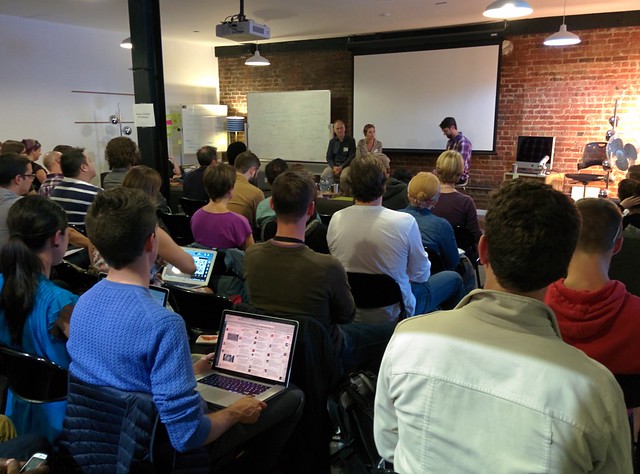
Jennifer Pahlka, CfA founder giving opening talk.

IMG_20150610_174738

Video of the event can be seen here:


Some notes from the demos:

Somerville

Citizens in Somerville have diverse origins, and hard for parents to get resources & info, so they made "Welcome packet" for the parents.

IMG_20150610_175317~2

Which student need help? What support do students need? How do we connect parents and teachers? The team created those dashboards.

IMG_20150610_175947

IMG_20150610_180039

Miami

Half of citizens in Miami are born overseas, districts are very complex, and people are often confused what service comes from where.

"Am I in Miami?"

IMG_20150610_180422

They gathered all of the stakeholders, drew processes and discussed.

IMG_20150610_180717

Feedbacks to the city were going nowhere and people stopped giving feedback since those voices were not heard, so the team is working on fixing the data process.

Old way of giving feedbacks.

IMG_20150610_180915

New feedback form: the government is using Google form!

IMG_20150610_181315

West Sacramento

Food system is huge & complicated, so the team is building a service called Urban Farm Locater.

IMG_20150610_183602

IMG_20150610_183819

Urban farmers are not always locals, so the team built an app for the farmers to communicate with locals.

IMG_20150610_184006

Albuquerque 

The team's mission is 1.connect communities 2.communicate what the mayor is doing 3. help make people employable

IMG_20150610_184737

IMG_20150610_184847

Tia Sabia, a website the team built helps people in need to understand all options, eligibility and time it will take to get assistance.

IMG_20150610_185038

Vallejo

The city wanted help to increase trust between police & community. Bankruptcy, police decrease, and murder increase made distrust among them.

"Police are people who are designed to help you. Why did we lose trust? Why are they no longer one of us? How can we help with their efficiency?"

The team is making a user friendly tool to report nuisance properties and a tool to explain service (Google for police) to increase efficiency.

IMG_20150610_185305

Pittsburgh 

They are tackling to fix the procurement of lifesaving equipments - opening market place, making playbook and clarifying inventory.

Photo

Their website:

IMG_20150610_193150

IMG_20150610_193552

Backend:

IMG_20150610_193609

Indianapolis

Fellows are helping to increase transparency - police open data census

https://codeforamerica.github.io/PoliceOpenDataCensus/

IMG_20150610_194158

Richmond 

The team is working on better healthcare- decrease time for appointment, increase patient trust and satisfaction.

IMG_20150610_195254

IMG_20150610_194546

IMG_20150610_195303

If you are interested in hearing more, Code for America Summit 2015 is happening on 9/30-10/2!
Website: http://www.codeforamerica.org/summit/

If you are interested in becoming one of the fellows, Code for America Fellowship for 2016 is now open, deadline to apply is July 15, 2015.
Website: https://www.codeforamerica.org/geeks/fellowship-apply/

Disclaimer: The opinions expressed here are my own, and do not reflect those of my employer. -Fumi Yamazaki

2015年2月22日日曜日

#CodeAcross & #opendataday in San Francisco

I joined Code Across / Open Data Day in San Francisco today.

Open Data Days are gathering of citizens in cities around the world to write applications, liberate data, create visualizations and publish analyses using open public data to show support for and encourage the adoption open data policies by the world's local, regional and national governments. There are 218 cities joining Open Data Day this year.

CodeAcross is a weekend of civic hacking events hosted by nodes of the Code for America network around the world. There are 60 cities joining CodeAcross this year.

Code Across 2015 SF

Housing and Affordability Projects

In the morning, I joined the Housing and Affordability teams led by SF Housing Action Coalition.

Code Across 2015 SF

This is the current situation of San Francisco... issues the fewest permits, and prices rise as a result.


Historically, SF was advanced in making affordable housing policy, making mandatory affordable housing for developers. Other cities such as Palo Alto, Oakland etc doesn't have that mandate. However things are not working...

Although there is demand for housing, San Francisco city can't tear down existing houses to make new housing for various reasons. Existing houses are usually more affordable than new houses- although some new complexes allow the former residents to come back, that is not the case for most new housings.

The Planning Commission has discretion over all building permit applications. Normally, this discretion is delegated to the Planning Department, which approves applications that meet the minimum standards of the Planning Code, including the priority policies of Code Section 101.1. F. From time to time the Commission will review a permit application. The Commission may determine that modifications to the proposed project are necessary in order to protect the public interest. If so, they can require the permit applicant to make the necessary changes. The Department will disapprove the application unless the required changes are made. This process of Commission consideration is commonly known as "Discretional Review".

Basically, during those processes if one person says no, the city can't build that building. The people saying "no" is very organized and very vocal, they currently live there, and care about sunlight, traffic etc that might be affected by those buildings. On the other hand, the people who wants to get the buildings built are much less organized and less vocal, since they do not have much incentive. They want housing but don't currently live in that specific area, and usually people has jobs and can't go to those planning committee hearings that sometime takes 4 hours. The decision makers needs to hear more "yes" to get those building built, which is currently not happening for all those reasons.

Affordable Housing projects proposals:

1. SF In Progress

Map of all proposed and current development projects, similar to SeattleInProgress:
https://www.seattleinprogress.com/

... and add alert system for Planning committee hearings:
-attend meetings
-email support
-video support

A couple of data sets for the project:

2. Map actual building stock in San Francisco

Create comprehensive datasets around: Where is there vacant housing? Who owns it all? Are apartment buildings being kept vacant by investors who don’t even live in the City?

3. Map zone optimization possibilities

Map overlay showing fully utilized zones vs current usage: Is there land currently being underutilized? Are there opportunities to build within current zoning requirements?
stat: 80% dev happening on 20% of land.

4. Development visualization tool

Build tools to help imagine what the site could look like with the proposed development.
ex. synthicity.com

Local Digital Services Census project

In the afternoon, I joined Local Digital Services Census project, which was doing a survey of the quality and usability of the 10 most-searched for digital services in each city.

https://service-census.herokuapp.com/


I did the census for San Francisco's scores for Requesting public information, and it was pretty painful. The things we look at are as follows:

-Can I navigate to it from the city’s homepage in three clicks?
-Does it come up in the first page of results on an internet search?
-Is the webpage with service or information mobile friendly?
-Can I complete the service online?
-Can I find a physical space alternative with location and hours?
-Is the service available in the major languages used in your city?

What San Francisco has for requesting public information is this FAQ page:

http://sfcityattorney.org/index.aspx?page=26

Which basically tells you to go to different departments to make the public information request, period. They don't list the contacts, they don't really help you get to the place where you can take action.


I tried to check what other cities has, and for example Oklahoma city has a form that their citizens can request public information online, which is a MUCH better experience.

http://www.okc.gov/clerk/openrecordsrequest/forms/submitopenrecordsrequest.aspx


Here's similar form for Palo Alto.

http://www.cityofpaloalto.org/gov/depts/clk/public_records_request.asp


I thought I was crazy not to be able to find something similar for San Francisco and started asking around to others including someone who works in the city, but we were unable to find it. If you find the right link/form for it, please let us know and we'll fix the scores, but for now (sadly) this was the reality.

Looks like Requesting public information is not easy across the board, though.

Other Teams' Projects

-World University wiki led by World University and School
They are making a wiki, and wants to add a section to share civic apps like Open911 etc

-Immigration, organize information
Immigration paper work is painful, so they want to make a service to organize info needed for those paperwork.

-Democratic engagement- Civility through dialogue
The team wants to help foster fair conversation between liberals and conservatives. They are not listening to each other on current platforms such as online comments, the team wants to gamify those interactions so that they talk to each other "by accident".

-Machine Intelligence- environmental review project led by SF BARF (SF Bay Area Renters' Federation)
Building permit process is taking too long, due to various reviews such as environmental review.
However, those impacts (such as traffic impact, soil impact, etc) should have historical data already.
The team is trying to use machine intelligence to measure those impact and gather environmental reports to start learning.

-Completing the geo web project
As seen in this Guardian article ("Cracks in the digital map: what the 'geoweb' gets wrong about real streets"), online services such as Yelp, Google Maps etc sometimes lacks what is in the real world. In particular, small businesses that don’t have existence in the web.
The team is going to create a service that allows small businesses to opt-in to have automatic profile created when they apply their business to the government.

-Neighborhood metrics
When you move into a new city, you really don't know what you can do within your neighborhood.
This team is planning to create a service which enable users to type in address, and it provides you with the metrics for your neighborhood such as air quality, water quality, etc and data for their local neighborhood.

-No Place Like Home Project
When residents are living in rent controlled apartment and told to move out by their landlord, they really don’t know if it is fair offer or not. The team is building a service for the users to check fair evaluation price of those buyout offers.
The team created this service called "No Place Like Home" a couple of weeks ago in a hackathon, and wants to recruit designers to help.

-Tenant advisor
They are going to create a mobile mockup to empower tenants with info such as renter's contracts and value proposition.

-Helping fight fraud in the internet
Good news: we have new 17 million internet users in 2014, the bad news: there were a billion dollars of damage by Internet fraud. The team is trying to fix that.

-Map data on 91,000 government entities
The team got a lot of data from government, planning to map them.
ex. http://publicsectorcredit.org/ca/en/cities

-Ohana Web Search
Ohana is an open library of social services, which is usually locked up in pdf, no way to search.
The team is working on the project to add search functionality.

Resources:

- Census mapping on affordability
http://s2t2.co/income_and_affordability

Photos:

Code Across 2015 SF

CodeAcross

Code Across 2015

Code Across 2015

Disclaimer: The opinions expressed here are my own, and do not reflect those of my employer. -Fumi Yamazaki

2014年12月24日水曜日

Technology’s Role in Creating a Better Government - 3 videos

3 videos from the civic tech space:

Google is a big supporter of Code for America and we've invited their co-founder Jennifer Pahlka to do an interview with Stephanie Hannon for the Women TechMaker program.

"Coder and activist Jennifer Pahlka believes that apps, built quickly and cheaply, are a powerful new way to connect citizens to their governments. Google's Steph Hannon chats about the future of Code for America and how to get involved."


We've also invited her to do a Techtalk at Google campus, and this is the video.

"Jennifer Pahlka is the founder and executive director of Code for America. She recently served as the US Deputy Chief Technology Officer in the White House Office of Science and Technology Policy. She is known for her TED talk, Coding a Better Government, and the recipient of several awards, including MIT’s Kevin Lynch Award, the Oxford Internet Institute’s Internet and Society Award, and the National Democratic Institute’s Democracy Award. She spent eight years at CMP Media, where she ran the Game Developers Conference, Game Developer magazine, Gamasutra.com, and the Independent Games Festival. Previously, she ran the Web 2.0 and Gov 2.0 events for TechWeb, in conjunction with O’Reilly Media. She is a graduate of Yale University and lives in Oakland, Calif. with her daughter, her fiance, and seven chickens. 
Can government be run like the Internet, permissionless and open? Coder and activist Jennifer Pahlka believes it can — and that apps, built quickly and cheaply, are a powerful new way to connect citizens to their governments — and their neighbors."


Julia Kloiber works at Open Knowledge Foundation and is the project lead for Code for Germany, which she describes in her recent TED talk "Let's build better digital tools for our cities!"

"When it came to getting public consensus on a complex plan to convert the epic Tempelhof Airport into something new, Berlin sought an effective way to communicate the nuances of the various proposals. The solution? A computer coder synthesized the information from all the options into a simple infographic, leading to an informed vote by the public. Julia Kloiber argues for the release of government data so coders can unscramble it for the public good - in Berlin and beyond."


Disclaimer: The opinions expressed here are my own, and do not reflect those of my employer. -Fumi Yamazaki

2014年9月4日木曜日

Code for America SF brigade hacknight memo

From my notes at meetup in San Francisco tonight: Jen Pahlka and Tim O'reilly were the speakers.

CfA brigade

- Let's put technology to the rightful place. It's not just about making money -technology can make society better.

- Should we be building something or reusing? Should governments be using taxpayers' money to build custom-made apps for each city?

- Change in vendor ecosystem is needed. 21st century governments can't survive without digital skill sets, tinkerers and builders.

- Government was our original means of collective action. It was built to do things that none of us could do individually. It’s wonderful to work together.

- Q: Technology will take away government people's jobs? A: Redeploy people to focus on outcome and actual people, don't get rid of them.

- Looking back on how Open Government advocacy started- it started by showing off people who are doing great things in the government, celebrate, and tell stories. Then, others who saw it will start doing it. That's how movements starts. That's how Tim started Open Source movement and other movements.

- 18F is deployment and USDS (US Digital Service) is about strategy and oversight. UK's GDS (Government Digital Service) actually does both.  Government realized they must spend less time just talking and more getting shit done ;)


 Disclaimer: The opinions expressed here are my own, and do not reflect those of my employer. -Fumi Yamazaki

2014年2月23日日曜日

Code Across SF 2014

Today, 2/22 is International Open Data Day! There are 167 hackathons happening all over the world.

http://opendataday.org/


This weekend is also CodeAcross 2014 - a weekend of events taking place in cities around the world, with the goal to activate the Code for America network and inspire residents everywhere to get actively involved in their community.

The theme for CodeAcross 2014 is "Beyond Transparency". We are going to take the open government movement one step further, by focusing on not only making data open, but actionable.

There are 47 event happening all over the world.

http://www.codeforamerica.org/events/codeacross-2014/


I joined Code Across in San Francisco, hosted at Code for America HQ. Code Across 2014 is focused on housing issues, which is a very hot topic in the city.

Code Across 2014

This is the schedule:

Code Across 2014

This is the projects we worked on.

Code Across 2014

SF Data Scorecard (US City Open Data Census)

This is the team I joined. Open Knowledge Foundation created US City Open Data Census website, in preparation for Code Across. We checked the SF Data Portal and updated information on San Francisco.


I worked on Crime incident report data in San Francisco.


It exists in many formats.


Licensed CC0.


I select venue, which dataset we will be registering, year, and the details.


Making progress!


And we're done! San Francisco is #1 among all of the Code Across cities :D


You can see the source code here, so replicate them to other countries.

https://github.com/okfn/opendatacensus

Code Across 2014

Housing Inventory

This team is working on creating a Housing Inventory list, which can be seen here.

Housing Inventory Community

Similar to the team above, but focusing on communities.

Code Across 2014

Anti-Eviction Mapping Project

They already have historical eviction data, so they are planning to make it searchable and visible.

Code Across 2014

SF Tenants Union Website

SF Tenants Union has a website with lots of data, but their website is not easy to use. This team is planning to revamp the website and make their data easier to use.

http://www.sftu.org/


Also there's this "Unlawful Detainer Procedures & Time Chart" that should be more user friendly...


SF Budget- Look at Cook

This team is digging out budget data from SF Budget, similar to Look At Cook


Bayview Footprints

http://www.bayviewfootprints.org/


Resources:

City Data Sources Related to Housing
Open Data Portal Hunt
Existing Curated Lists of Housing Data

Events:


Date
Event
3/28-30
Reallocate is doing a hacktivation on homelessness
2/25
Tech workers against displacement. Sup. David Campos speaking. Virgil’s.
3/5
Project homeless connect - in Bill Graham - get any services you need on one day. Accepting volunteer help (medical checks, public services, etc.). Go to Project Homeless Connect - accepting volunteers ahead of time. Fantastic volunteer opportunity. Duplicated 200+ times throughout the world and started here in SF!!! Connects homeless population with acute needs.
3/20
Geeks for Good - mostly design agencies doing a design jam for non-profits etc. Ignite talks!
3/3
Homeless coordinating board - Full board meeting
Every Thurs
Planning commission meets at Noon. Agendas are online the week before.
Ongoing
Set up a keyword alert regarding upcoming legislative hearings (Legistar)
2/26
SPUR - forum to talk about good urbanism
Date?
Feedback meeting for budget. There were notices on bus stops. Could be very relevant to housing.
Date?
Events surrounding the Ellis Act
Resource. Dates?
Tenants together coordinates protests and action on a state level.  Eviction free SF is another good  one.
2/24
Land use and development board meeting at 1.30pm. All hearings are online - Granicus. All meetings are taped by SFGov.tv - videos available on demand through their website - sfbos.org
Resource.
Facebook group - TechForGoodSF


Board of Supervisors past meeting videos and agendas: http://sanfrancisco.granicus.com/ViewPublisher.php?view_id=10


Board of Supervisors upcoming meetings:

Disclaimer: The opinions expressed here are my own, and do not reflect those of my employer. -Fumi Yamazaki