ラベル civicinnovation の投稿を表示しています。 すべての投稿を表示

2015年6月4日木曜日

Understanding America's "Interested Bystander:" A Complicated Relationship with Civic Duty

My teammates at Google Civic Innovation team conducted a research on What motivates American citizens to do things that are civic, and released the report "Understanding America's Interested Bystander".


Blog post is here

Slides:


Report:


Video:


Top insights

  • According to our research, almost half of the United States adult population could be considered “Interested Bystanders” – 48.9% of people are paying attention to issues around them, but not actively voicing their opinions or taking action on those issues.
  • There is a misalignment between how Interested Bystanders think they should engage civically, and the ways they actually engage. Interested Bystanders are not taking the political actions they say they value. On the flip side, they underrate what they are actually doing now as civic actors. While Interested Bystanders associate the political aspects of civic life with conflict, shame, and negative experiences, they are attracted to the aspects that are about community involvement and social relationships.
  • While Interested Bystanders say that power comes from having a voice, they are disinclined to share their own opinions. Additionally, many Interested Bystanders are uninterested in hearing the opinions of other people.
  • While many Interested Bystanders believe they have the most power at the local level — either because they have greater ability to influence others in their immediate circles, or because they feel proportionally more important in a smaller population — most participants reported voting only at the national level, indicating a tension between their voting choices and their own sense of efficacy.
  • When they do take civic action, Interested Bystanders do things that meet the public interest most often when it aligns with their self interest. They tell us that they are most often motivated by one of three reasons: 1) they have personal or professional experiences to bring to bear, 2) they have personal interests at stake, or 3) they wanted the satisfaction of an emotionally meaningful experience.

This research was conducted only in US so we do not have any report from elsewhere, but made me start to think about baseline data of Japan.

- 2014 Japanese lower house election marked the lowest voting turnout with 52.66%, breakdown of lower house election turnout rate by age as follows.


Data Source: Ministry of Internal Affairs and Communications

-Breakdown of Japanese upper house election turnout rate by age as follows.


Data Source: Ministry of Internal Affairs and Communications

-Voting turnout of Japanese local elections.


Data Source: Ministry of Internal Affairs and Communications

This data is a bit old, but in 2011 elections for prefecture had the turnout of 48.15% and city/town/village level local election was 49.85%. (Prefecture election turnout in 2014 further decreased to 45.05%- Data Source NHK)

-Reasons for not going to vote in Japan:
27.0% replied they had to work, 24.1% had other important things to do, and 18.4% said they did not have candidate nor political party they wanted to vote.

Data Source: Ministry of Internal Affairs and Communications

Compared to US where the citizens know they should "ask not what your country can do for you — ask what you can do for your country", Japanese citizens seems to rely more on the government to be functional and provide what you need.... and I think the Japanese government seemed to function well in the past - we had very low crime rate and police was functioning well, we have much better healthcare system and people are treated well, we have a very good public infrastructure including roads, railroads and telecommunications. However, after 311 the big earthquake, tsunami and nuclear power plant accident, Japanese citizens started to realize not to depend too much on the government and start taking civic actions such as volunteering, donating and community organizing.

This is data is from 2001 which is before 311 disaster. It shows the breakdown of volunteer activities by age- teenagers are doing a lot of volunteer activities, decreases when they become twenties and then as they grow older they re-engage with volunteering more.


Data Source: Japanese Statistics Bureau and Statistics Center

As for the contents of volunteering, 14% are engaged in city planning, 8% on protecting nature and environment, 5.5% on safety and 5.3% for children, 5.1% for elderly and 4.6% for health and medical services. Since this is from 2001, volunteering for natural disasters was very low, only 1.4% back then.


Data Source: Japanese Statistics Bureau and Statistics Center

Then there was the disaster. Japanese citizens who engaged in volunteering for natural disaster between October 2010 to September 2011 was 4.3 million people (tripled from 2006), among which 2.4 million were women.

Data Source: Japanese Statistics Bureau and Statistics Center

Age breakdown as follows (green line is data from 2011, red line is from 2006)


How the Public Views Open Government Initiatives
Why Millennials Don't Vote For Mayor: Barriers and Motivators for Local Voting

Disclaimer: The opinions expressed here are my own, and do not reflect those of my employer. -Fumi Yamazaki

2014年9月2日火曜日

Guides on "How to run Civic Hack Nights"

There are many guides on "how to run civic hack nights" recently, so I decided to compile a list here:


How to: Hack Night


Civic Hacking 101 by Christopher Whitaker


How to Hack Night panel


Disclaimer: The opinions expressed here are my own, and do not reflect those of my employer. -Fumi Yamazaki

2014年8月16日土曜日

Civic User Testing Group in Chicago

The Civic User Testing Group is a set of regular Chicago residents who get paid to test civic apps.

The problem in current civic tech space is that lots of civic apps get attention among a smallish group of other developers and people interested in the world of open data, but do not get wide acceptance by the people they were made for — regular residents of the city of Chicago. That is why they made this testing group.

Website: http://cutgroup.smartchicagoapps.org
The CUT Group Book by Dan O'Neil: http://www.cutgroupbook.org/

This is how it works:
1. Testers fill out a CUTGroup profile and sign up to be a tester of civic apps.
2. CUTGroup sends a $5 VISA gift card.
3. If and when the tester choose to test a civic app, they get paid a $20 VISA gift card.

They have over 800 Chicago residents signed up for this program, from all over the city– all 50 wards, all 77 community areas.

It's a chance for everyone to learn- residents learn about civic apps, developers learn about what users think about their apps and about user testing, and governments learn about what people cares about.

Civic User Testing Group is run by Smart Chicago Collaborative, a civic organization devoted to improving lives in Chicago through technology. They work on increasing access to the Internet, improving skills for using Internet, and developing meaningful products from data that measurably contribute to the quality of life of residents in their region and beyond.

Website: http://www.smartchicagocollaborative.org/

Daniel O'Neil, executive director of Smart Chicago Collaborative talked about the Civic User Testing Group at Code for America Summit in 2013, video, slides and script (blog post) as follows.


Blog post by Dan "Civic User Testing Group as a Model in Changing the Relationship Between Government and Residents (#cfasummit)"

They reach out to all districts, runs the tests in open places (since not everyone in the world has access to Internet), such as libraries, health centers, community rooms, public computer centers, etc.

Their motto is "If it doesn't work for you, it doesn't work".

"We have to include everybody. And everybody means everybody. And the only way we can do that is by consciously and deliberately developing systems for inclusion. Going beyond our own Twitter ping-pong retweet chambers. Beyond our own wants, beyond our own physical spaces, into a real communion with residents." says Dan.

The following video depicts CUTGroup release explanation - in plain language that everybody understands. Getting the testers understand exactly what they are doing, why they are doing this, and about model release, etc is super important.


You can see many of the actual testing in this Playlist, and here are some examples.

https://www.youtube.com/playlist?list=PLJ75D_m2b5GvdTWz23nmy-tewNz6CdmZH

CUTGroup #7: EveryBlock iPhone App - Tester #2


CUTgroup #4: Eatsafe - Tester #2


How are they funded? Civic User Testing Group is supported by a Knight Community Information Challenge grant provided jointly by the Knight Foundation and The Chicago Community Trust as part of the Civic Innovation in Chicago project, with additional funding by the John D. and Catherine T. MacArthur Foundation.

So the next question is how can we replicate this in other cities? The problem is not unique to Chicago- it is applicable to all civic tech communities globally. But we don't have Chicago Trust Community and MacArthur Foundation everywhere, and so we need to be creative and start thinking about how we can do something similar in YOUR city.

Article on Chicago Tribune:
Harris: Finding 'real people' to test civic apps 
Daniel O'Neil of the Smart Chicago Collaborative aims to engage city residents in the process of building civic-minded technology

Update 2/20/2015:
Civic User Testing Group is starting in Oakland!
http://cutgroup.openoakland.org/


Disclaimer: The opinions expressed here are my own, and do not reflect those of my employer. -Fumi Yamazaki

2014年4月30日水曜日

2014 Google Personal Democracy Fellowship

Women who wants to join Personal Democracy Forum, listen up!

Personal Democracy Forum is a conference that crosses the world of technology and politics. PDF brings together a thousand top opinion makers, political practitioners, technologists, and journalists from across the ideological spectrum for two days to network, exchange ideas, and explore how technology and wired citizens are changing politics, governance, and civil society.

This is the video of keynote from last year by Catherine Bracy of Code for America, "What Techies Need to Know About Politics"


This year, PDF will be held on 6/5-6 in New York at NYU’s Skirball Center, and the theme is “Save the Internet | The Internet Saves,” focusing on the ways people can work together to keep the Internet open for free speech and association, and how the Internet itself helps make society and civic life more open, participatory, and innovative.

https://personaldemocracy.com/conferences/nyc/2014


This year's speakers include:
Clay Shirky Professor, NYU Interactive Telecommunications Program
Bruce Schneier Author & Security Technologist
Jillian York Director, Electronic Frontier Foundation
John Paul Farmer Senior Advisor, White House Office of Science & Technology Policy
Rebecca MacKinnon Co-founder, Global Voices Online
Sue Gardner Executive Director, Wikimedia Foundation
Barton Gellman Journalist, The Washington Post
Ben Berkowitz Founder/CEO, SeeClickFix
Shannon Dosemagen Co-founder, Public Laboratory
And my colleague from Civic Innovation Team, Google - Anthea Watson Strong is speaking this year too.

In order to support female civic innovators who are wanting to join PDF, Google and Personal Democracy Media are teaming up to offer registration and travel fellowships for women working in civic technology to PDF 2014.

For the 2014 Google PDF Fellowship, we're looking for 15 women who are working to keep the Internet open or working on ways the Internet makes democracy stronger, or both. To apply, take a few minutes to fill out the application form by 12 noon EST on Thursday May 1, 2014 to tell us more about yourself and how you’re thinking bigger. Fellowships cover the full registration costs and include a meal with Googlers during the conference and possible partial travel stipends. All applicants will receive notifications regarding decisions by May 9, 2014.

You can apply here:
https://docs.google.com/a/google.com/forms/d/1FiD3CBGrHuZ-1x4ybAhl72efKmHMzGtjNNtPynClKiA/viewform

Disclaimer: The opinions expressed here are my own, and do not reflect those of my employer. -Fumi Yamazaki

2014年4月29日火曜日

Bicycle Rules in San Francisco

This is the bicycle accident map of San Francisco that was created by Sep Kamvar, researcher in MIT Media Lab. His team is actually releasing one map per day, for 10,000 days, with 10,000 maps of 100 cities x 100 maps each.


As a cyclist living in San Francisco, I am excited that those accidents are visualized, and am interested in clarifying the reasons for those accidents, and working to fix it so that San Francisco becomes a safer city for cyclists. May 8th is 20th anniversary of Bike to Work day in San Francisco, and May is the Bicycle Month in San Francisco. What a perfect timing ;)

Also note that the San Francisco Municipal Transportation Agency (SFMTA) released its 2013 Bicycle Count Report, which shows that the number of people biking in San Francisco increased a dramatic 96% since 2006.


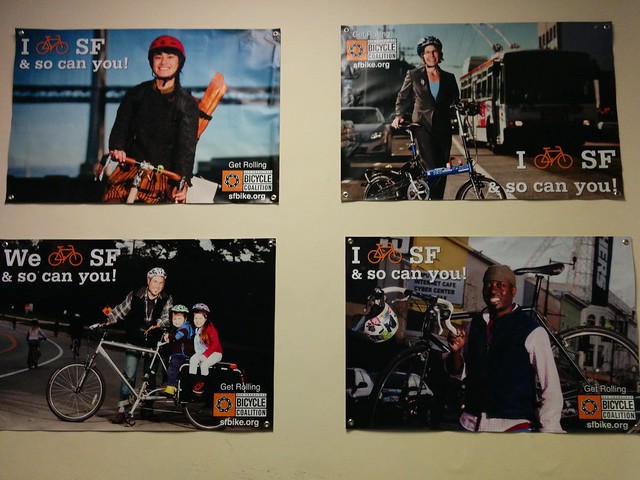
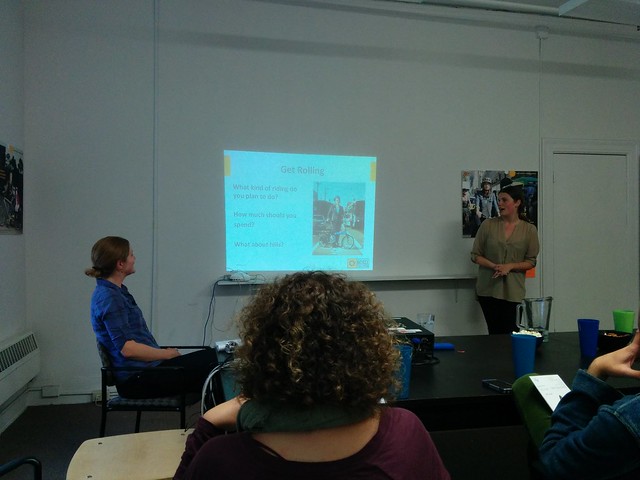
So I went to one of the workshops that San Francisco Bicycle Coalition puts together to explain about the rules of biking in SF. If you're new to SF and are biking, I highly recommend you do so too, because the rules and regulations differs country to country, and what was common sense in Japan is not the norm here.

SF Bicycle Coalition

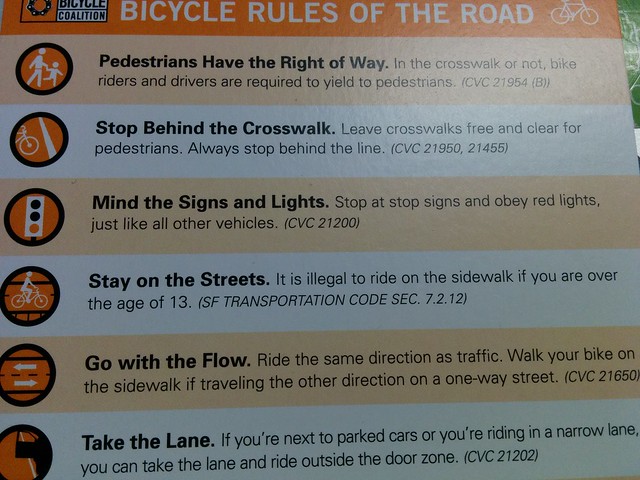
Rules of the road:

Some important snippets from California Vehicle Code, you can find the information to the links to related codes here.

SF Bicycle Coalition

SF Bicycle Coalition

PEDESTRIANS HAVE THE RIGHT OF WAY 

In the crosswalk or not, bike riders and drivers are required to yield to pedestrians. (CVC 21954 (b))

STOP BEHIND THE CROSSWALK 

Leave crosswalks free and clear for pedestrians. Always stop behind the line. (CVC 21950, 21455)

If not, you can get expensive ticket (looks like more than 200 USD fine...) I see many cyclists every day blocking the pedestrians by going to the first white line, not the second line. They're all subject to 200 USD fine? Wow...

Bike

MIND THE SIGNS AND LIGHTS

Stop at stop signs and obey red lights, just like all other vehicles. (CVC 21200) 

In California, a person riding a bicycle or operating a pedicab upon a highway has all the rights and is subject to all the provisions applicable to the driver of a vehicle by this division.... Stop at stop signs and obey red lights, just like other vehicles. In other countries if you are biking you are not treated the same as people driving cars- but here in California, you are subject to provisions similar to a car driver. Wow. Violation of $85.00. BTW, in California, bikes can ride on highway by law.

Also, at cross sections, many of bikers are sort of wiggling their way during red lights- according to this workshop, police can fine you for not obeying the red light- putting your feet on the ground is safest way to prove you were obeying the red light. Wow.

STAY ON THE STREETS 

It’s illegal to ride on the sidewalk if you are over the age of 13. (SF Transportation Code Sec. 7.2.12)

Repeat, IT IS NOT LEGAL TO BE ON SIDEWALK in San Francisco. In some countries, since car lanes are dangerous, bicycles ride on sidewalks. Beware, don't do that in SF!

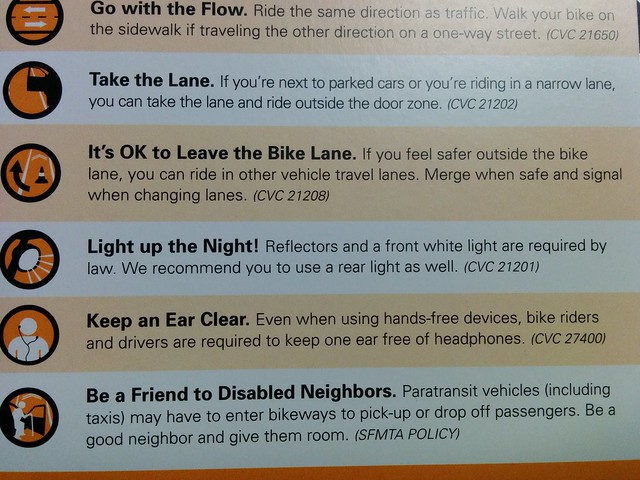
GO WITH THE FLOW 

Ride the same direction as traffic. Walk your bike on the sidewalk if you find yourself on the wrong block of a one-way street. (CVC 21650)

There's lots of one-way streets in SF, so be careful which way you go.

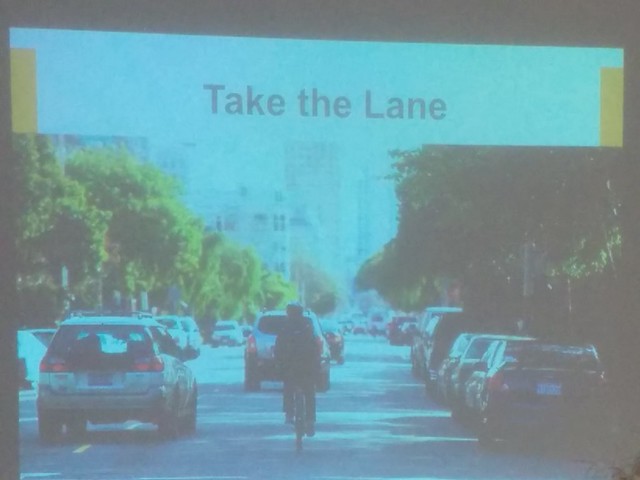
TAKE THE LANE 

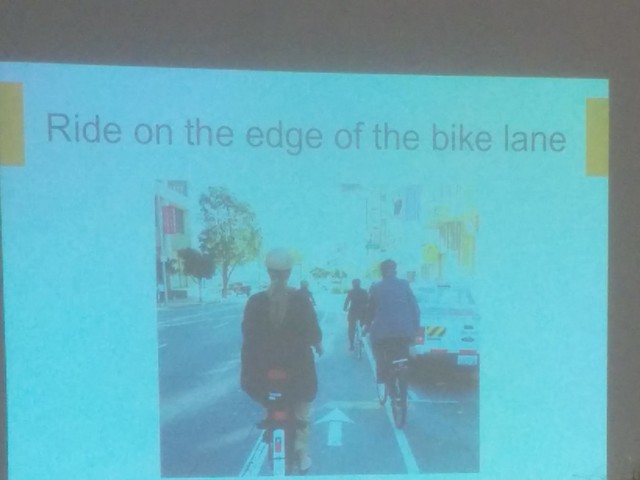
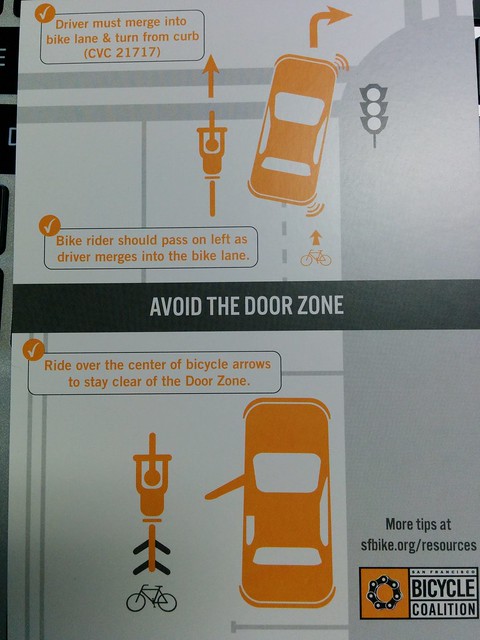
If you’re next to parked cars or you’re riding in a narrow lane — if you feel safer, take the lane and ride outside the door zone. (CVC 21202)

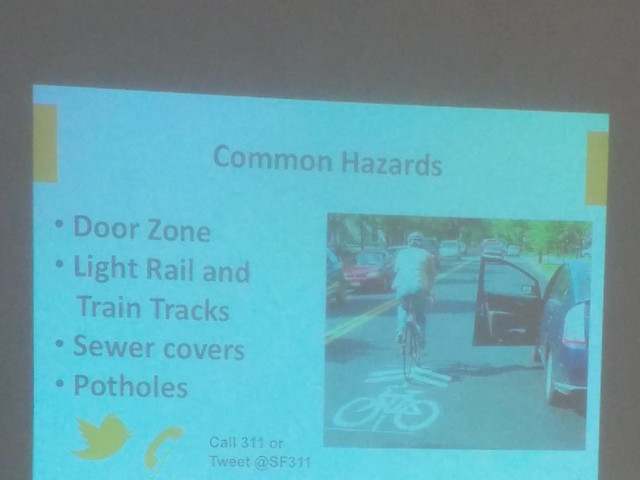
Door zones is one of the common hazards for bike riders in SF.

SF Bicycle Coalition

When they say "take the lane" what do they mean? Reading the CVC21202:
21202. (a) Any person operating a bicycle upon a roadway at a speed less than the normal speed of traffic moving in the same direction at that time shall ride as close as practicable to the right-hand curb or edge of the roadway except under any of the following situations: (1) When overtaking and passing another bicycle or vehicle proceeding in the same direction. (2) When preparing for a left turn at an intersection or into a private road or driveway. (3) When reasonably necessary to avoid conditions (including, but not limited to, fixed or moving objects, vehicles, bicycles, pedestrians, animals, surface hazards, or substandard width lanes) that make it unsafe to continue along the right-hand curb or edge, subject to the provisions of Section 21656. For purposes of this section, a "substandard width lane" is a lane that is too narrow for a bicycle and a vehicle to travel safely side by side within the lane. (4) When approaching a place where a right turn is authorized. (b) Any person operating a bicycle upon a roadway of a highway, which highway carries traffic in one direction only and has two or more marked traffic lanes, may ride as near the left-hand curb or edge of that roadway as practicable.
Does this cyclist seem to be doing the right thing?

SF Bicycle Coalition

In California, yes. In Tokyo, no. In California, yes because it is bicycle riders' responsibility to ride far enough from the automobile doors to open. In Tokyo, this bicyclist is riding too much into the car driving zone and unsafe.

On this photo, which bicycle is doing the right thing?

SF Bicycle Coalition

In California, the woman in the left, because she is taking necessary distance from the parked car. In Japan, probably the man in the right, since he is avoiding getting hit by the moving cars. In Japan, bike riders are assumed weaker on the road and meant to protect themselves. In California, bike riders are assumed stronger on the road and meant to protect others (such as people coming out of the cars, etc.) The woman in the left works for SF Bike Coalition and the man in the right is mayor of SF, by the way.

Also, look at the picture below:

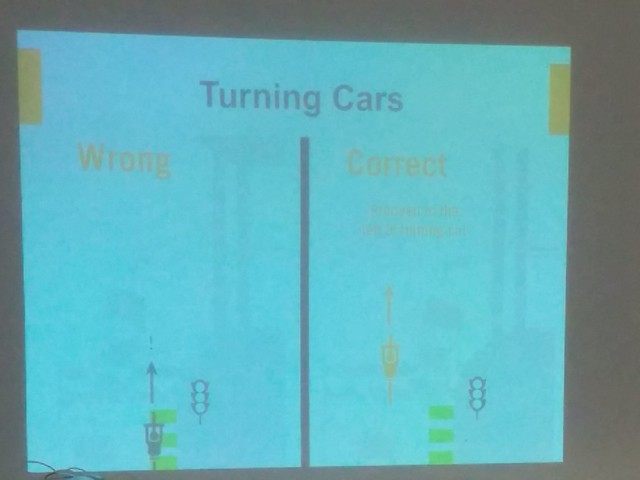
In San Francisco, car drivers are required by law to merge into bike lane when turning right (CVC 21717). So what happens is that bike riders needs to pass on left of the cars.

SF Bicycle Coalition

So a bike rider, if you stay in the far right (that you usually try to stick), you're doing it wrong.

SF Bicycle Coalition

By the way, do you know how to make left turns in San Francisco? You go all the way to the center of the crossway, and turn left. (Or, you cross the lane forward, and wait for the other traffic signal to change, and cross left.) This is prohibited in Japan, but legal in SF...


Source: Metropolitan Police Department, bicycle rules

IT’S OK TO LEAVE THE BIKE LANE 

If you feel safer outside the bike lane, you can ride in other vehicle travel lanes. Merge when safe and signal when changing lanes. (CVC 21208)

Wow, I was amazed there's a provision for that. I thought that was a matter of course.

LIGHT UP THE NIGHT 

Reflectors and a front white light are required by law. We recommend you use a rear light as well. (CVC 21201)

KEEP AN EAR CLEAR 

Even when using hands-free devices, bike riders and drivers are required to keep one ear free of headphones. (CVC 27400)

BE A FRIEND TO DISABLED NEIGHBORS 

Sometimes people with disabilities need access to the curb. Paratransit carriers (including taxis) may have to enter the bikeway to drop them off. Be a good neighbor and give them room. (SFMTA Policy)

Also, I was reading more on CVC and found this provision: CVC 21963 Visually Handicapped Pedestrian "A totally or partially blind pedestrian who is carrying a predominantly white cane (with or without a red tip), or using a guide dog, shall have the right-of-way, and the driver of any vehicle approaching this pedestrian, who fails to yield the right-of-way, or to take all reasonably necessary precautions to avoid injury to this blind pedestrian, is guilty of a misdemeanor, punishable by imprisonment in the county jail not exceeding six months, or by a fine of not less than five hundred dollars ($500) nor more than one thousand dollars ($1,000), or both."

Other tips:

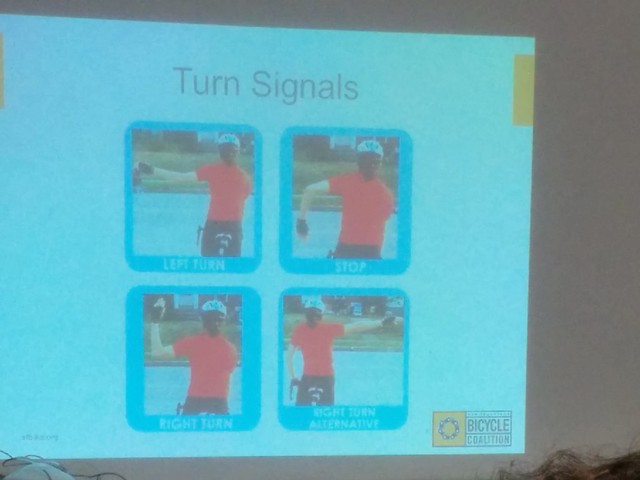
So what is the advice to avoid accidents? SF Bike Coalition says "Ride predictably". Make your movements predictable to others on the road, so that you can ride more safely.


-Make yourself visible
-Use turn signals with your hands
-Eye contact with the drivers

SF Bicycle Coalition

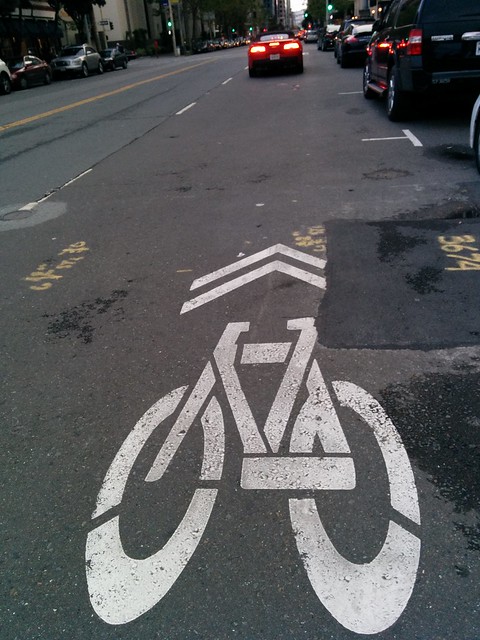
When you see this mark, do you think this is a bike lane?

San Francisco

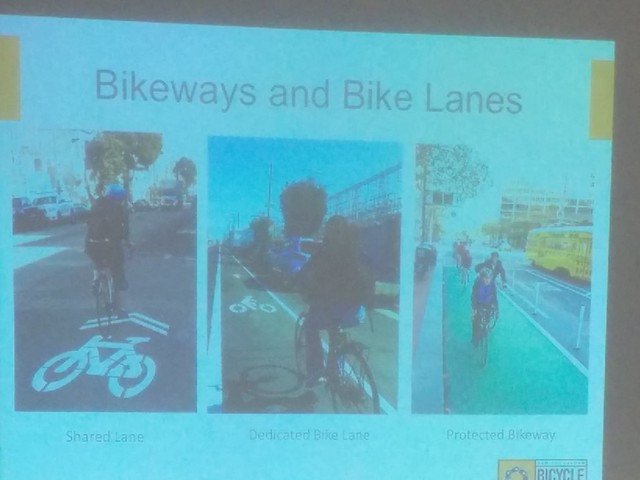
It has a bicycle picture, so coming from outside SF, you'd probably think yes. The answer is no. This is called shared lane, both for bicycles and cars.

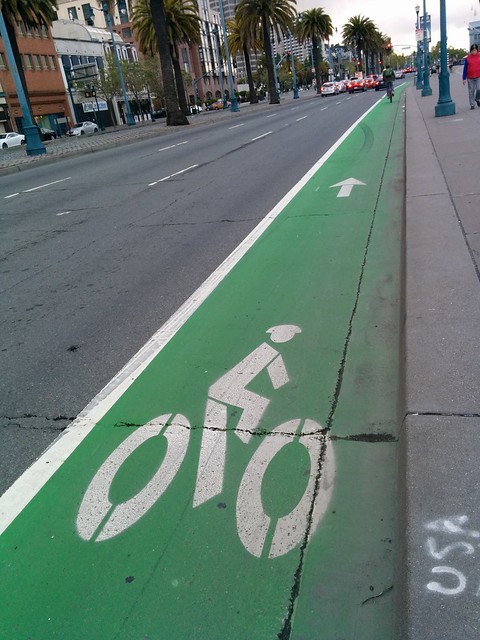
Bike lanes look like the following here.

San Francisco

SF Bicycle Coalition

Other tips they mentioned:


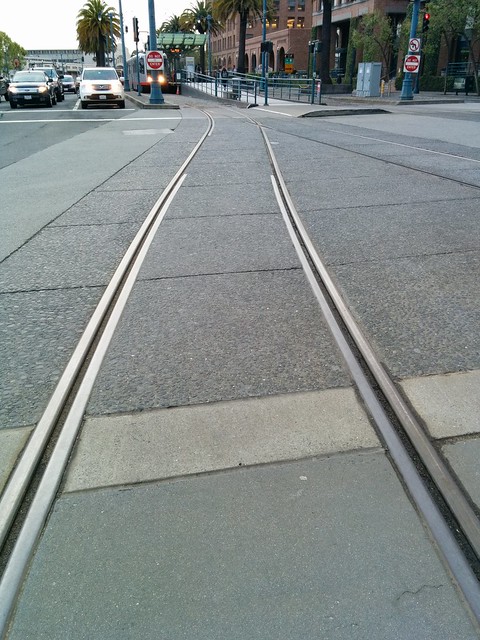
Avoid riding parallel to train tracks - In San Francisco, there are light rail and train tracks. Try to cross on 90 degree angles, don’t change angle while crossing the rail - go across then turn. Try to avoid riding parallel to the rails- your wheel can get stuck.

San Francisco

Helmet is required by law for people under 18, and violation of this law can result in a $25 fine. But helmets are recommended for everyone including adults.

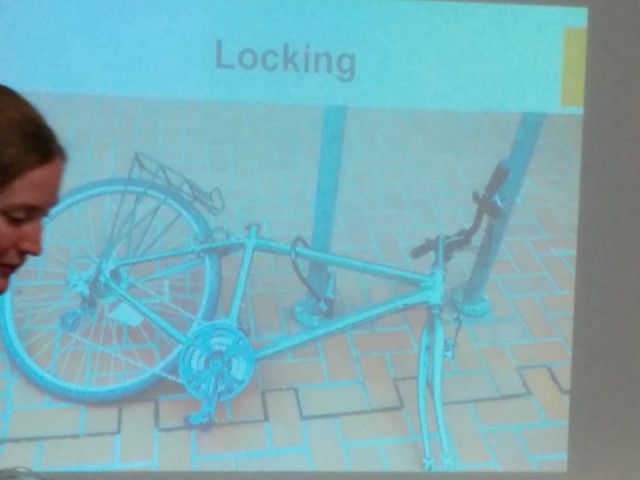
Buy the U Lock key, and lock your bike!!! There are lots of bike theft in San Francisco. This is how to lock your bike. Make sure you register your bicycle to the bike registry system.

SF Bicycle Coalition

In San Francisco, weather change a lot. Have layers of cloths, scarf is convenient.

Bike safely in SF!

SF Bicycle Coalition

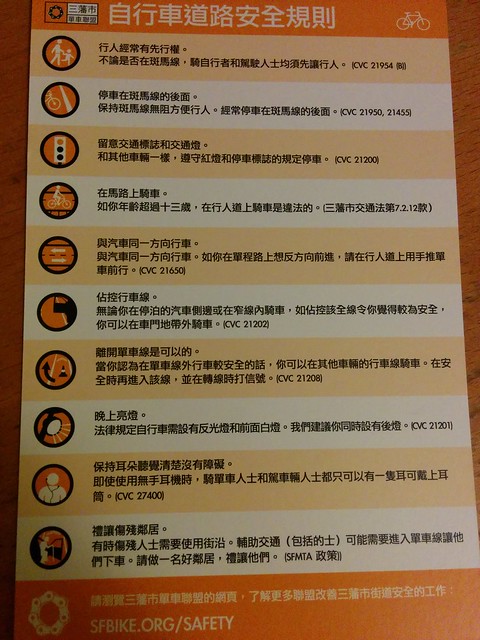
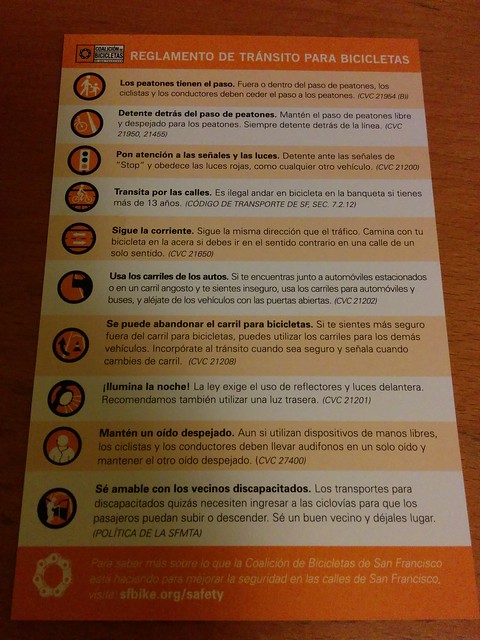
BTW, they had the road rules in Chinese and Spanish as well.

SF Bicycle Coalition


SF Bicycle Coalition

Disclaimer: The opinions expressed here are my own, and do not reflect those of my employer. -Fumi Yamazaki
2014年2月7日金曜日

Open Oakland Civic Hack Night

I joined Open Oakland (Code for America Oakland Brigade) Civic Hack Night this Tuesday.

They host their weekly hack nights in this beautiful City Hall.

Oakland

Getting inside the city hall to join the hack night. Very cool!

Oakland

Oakland

Oakland

Due to heavy traffic from Mountain View to Oakland, I arrived a bit late and the room was already packed! I loved the diversity of the people who joined here- some are developers some are not, good mixture of gender and age, etc. I was also fascinated by the fact that the lady who sat next to me was saying she came to this meetup because she saw it on Oakland City's website. It's different from the techies we always meet in every single tech event. Also since this event is held inside the City Hall, I think it is easier for the local government people to join. I didn't talk with everyone, but I saw a lady from the local government in the ethics division joining the campaign finance team, which is really awesome.

Oakland

Oakland

Pizza arrived, mingling time and break out to teams. I joined the Newbie orientation.

Oakland

This was the biggest team, they are planning for the CodeAcross event taking place on 2/22-23. They were discussing which companies are going to be involved, how to keep track and keep on progress of the projects, etc.

Oakland

In fact, CodeAcross is happening all over the country on 2/21-23 so please check out and join the nearest one!

http://www.codeforamerica.org/codeacross-2014/


This team was working on transparency of campaign finance. It is important because election is close. There are many things to think about- data cleaning, understanding of the data itself, the companies, people, etc. They were also discussing about visualizing lobbyist data.

This is work in progress website created by John C. Osborn, based on data from Public ethics commission.


Open Oakland

This team was working on crime data. This is also very important because Oakland is known for crime (map).

Oakland

This team was working on getting various social resource data such as shelter location data online and map them.

Oakland

Project list from Open Oakland:

Oakland Open-Data Portal: Community supported open data portal

Open Budget Oakland: Open Budget is a project to make Oakland’s budget more accessible.

Open-Government Pledge: During the 2012 election, 15 of 27 candidates signed the Open Government Pledge—including 4 of 6 elected—committing to uphold the principles of transparency, participation, and collaboration in Oakland government.

CityCamp Oakland: CityCamp Oakland brings together citizens, city government, and businesses to openly innovate, enhance transparency and civic engagement, and utilize open-source technology to improve quality of life in our communities.

Crime in Oakland: Providing access to Oakland Police Department data.  Things like redeploying the crime trends app built by Open City Apps become possible.

OaklandBeats.com: A simple app to help connect people to their local Neighborhood Crime Prevention Councils.


Adopt-a-Drain: A platform that allows citizens to adopt and clear their local storm drains to prevent flooding.

EarlyOakland.com: A free website about to help parents find free and low cost child care and early education services.

Oakland Wiki: A free website about Oakland that anyone can edit. The community-built site all about Oakland, by Oaklanders.

Councilmatic Oakland: A public meeting indexing and search tool.

Vacant and Abandoned Property Tool: Adapting the vacant / abandoned locator built by Open City Apps or the BlightStatus app built by Code for America.

When I arrived at the city hall, there was a message in front of the building that read "Stop the Spy Center".

Oakland

There were a bunch of protesters walking outside during our event. I heard it is to protest against the Oakland surveillance center.

Oakland

By the time I left, it was past 9PM or so, but there was more protests on surveillance outside the city hall.

Oakland

Learning more about this Domain Awareness Center.

The Real Purpose of Oakland's Surveillance Center
Domain Awareness Center (Oakland Wiki)
Oakland looks into more surveillance, drones to fight local crime


Disclaimer: The opinions expressed here are my own, and do not reflect those of my employer. -Fumi Yamazaki